Discovery No. 009 · Molecular property prediction
On ESOL, a fused-descriptor MLP matches a graph neural network at a quarter of the GPU time
The question
ESOL is one of the most-cited regression benchmarks in molecular machine learning. Eleven hundred and twenty-eight small molecules, each with a measured aqueous solubility, and a long line of models reporting an RMSE on it: linear models, random forests, gradient-boosted trees, and, since 2019, the directed message-passing neural network (D-MPNN) that Chemprop made the default strong baseline for property prediction. The graph network learns its own representation from the molecular graph and runs on a GPU. The descriptor models take hand-built features and mostly run on a CPU.
The leaderboard question, "which model has the lowest RMSE," has been asked many times. We ask a different one, the one that decides whether the GPU is worth turning on: once every model is trained and tested on byte-identical splits and the wall-clock is measured, how much accuracy does the graph network's GPU time actually buy? A benchmark this over-studied is exactly where a compute-controlled answer is missing, because almost no one reports the cost next to the accuracy.
The novelty gate
Before running anything we checked whether this had been answered. Yang et al. (2019) establish the D-MPNN as the ESOL baseline but report accuracy with no wall-clock budget. Jiang et al. (2021) show that descriptor models rival graph models on several MoleculeNet tasks, but they compare final accuracy only and never report the GPU time each model spends. Wu et al. (2018) define the task and the scaffold split but predate the D-MPNN and account for no compute. So the accuracy comparison exists and the cost comparison does not. A measured compute-versus-accuracy frontier on ESOL, with matched splits and a negative control, is the gap. That frontier is the study.
What we did
Every model on a given fold saw the identical train/validation/test partition, generated once by Chemprop's own scaffold and random splitters, so the comparison is apples to apples rather than each method splitting its own way. We ran five scaffold replicates and five random replicates and report the mean with a 95% confidence interval.
Four learners, plus a control:
- Ridge on the fused features. The linear floor.
- LightGBM on the fused features. Gradient-boosted trees, CPU.
- Fused-descriptor MLP. A small regularized multilayer perceptron on standardized RDKit 2D descriptors concatenated with log-count Morgan (ECFP4, radius 2, 2048 bits). This is the cheap GPU model.
- D-MPNN. Chemprop 2.2.3, the graph network, on the same splits.
- y-scramble. The MLP with its training targets permuted, so no real structure-activity signal can survive. The negative control.
For every model on every fold we recorded the fit-plus-predict wall-clock in seconds, which is the axis the literature omits.
The finding
One. The graph network's GPU premium buys no measurable accuracy on ESOL.
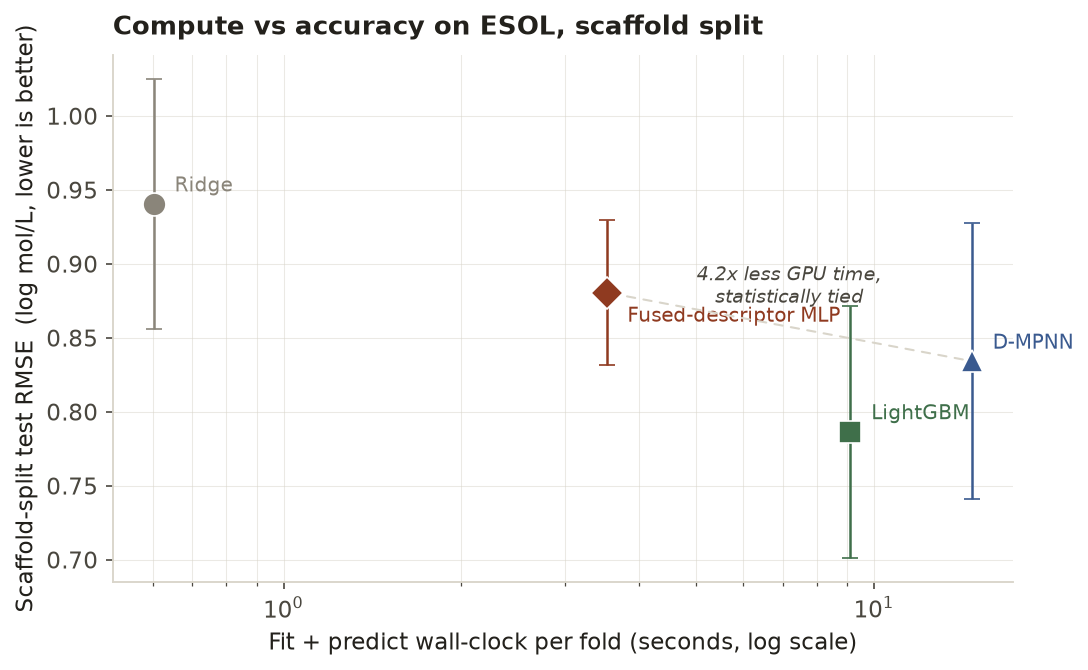
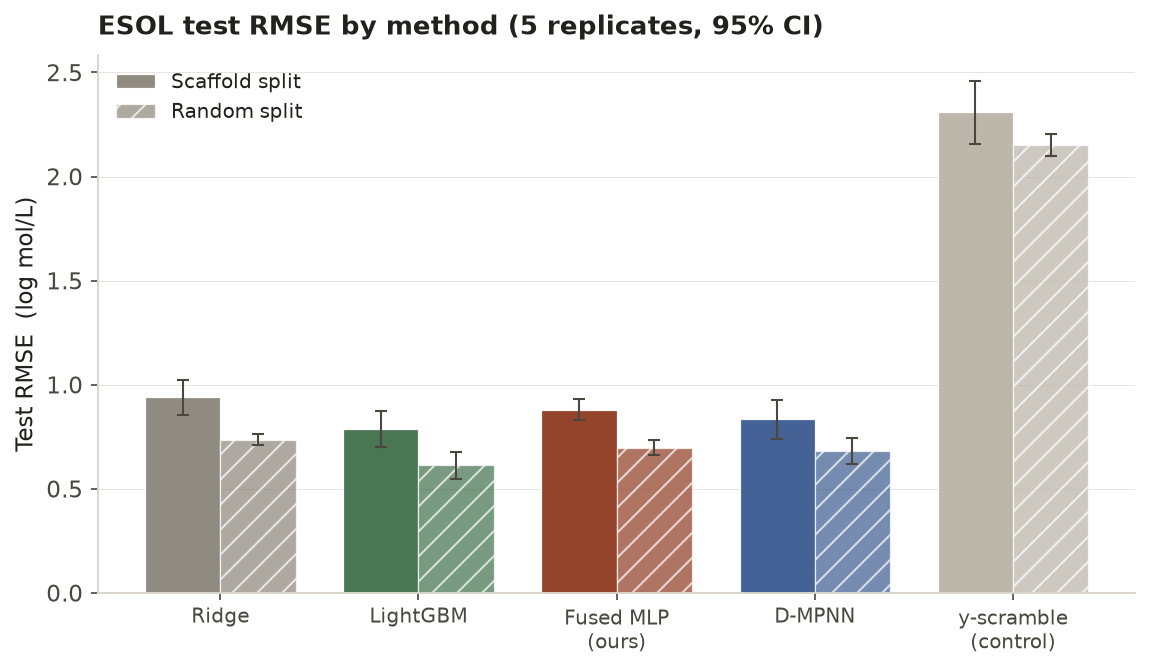
On the scaffold split the fused-descriptor MLP reaches 0.881 plus or minus 0.049 RMSE; the D-MPNN reaches 0.834 plus or minus 0.093. On the random split the MLP reaches 0.697 plus or minus 0.036 and the D-MPNN 0.682 plus or minus 0.064. On both splits the confidence intervals overlap and the means differ by less than one standard error: the two models are statistically tied. The difference is the clock. The MLP fits and predicts a fold in 3.5 to 4.1 seconds; the D-MPNN takes 14.6 to 14.8 seconds, on the same A40. The graph network spends 3.6 to 4.2 times the GPU wall-clock to land in a dead heat.
Two. If accuracy is all that matters, no GPU is needed at all.
LightGBM on the identical features is the frontier winner outright: 0.787 plus or minus 0.085 on the scaffold split and 0.612 plus or minus 0.064 on the random split, ahead of both deep models, on a CPU. The honest reading of ESOL is that the molecular signal it rewards is already captured by standardized descriptors and a count fingerprint; a graph network that re-learns a representation from scratch reaches the same place more slowly, and a boosted tree on the features beats it.
The control holds. y-scrambling collapses the MLP to 2.31 RMSE on the scaffold split and 2.15 on the random split, far above every real learner. The signal the models exploit is genuine structure-property information, not a leak in the pipeline.
Why it matters
This is not a claim that graph networks are useless for chemistry. On larger datasets, on tasks where the right descriptors are unknown, or where the graph carries information a fingerprint discards, a learned representation can earn its compute. The claim is narrower and it is measured: on ESOL, the specific benchmark where the D-MPNN is most often cited, the GPU premium is unrewarded. The frontier is flat across three of the four learners and a CPU tree sits at its corner.
The reusable contribution is the protocol. Hold every model to one set of splits, record the wall-clock next to the RMSE, run a y-scramble control, and report the frontier rather than a single leaderboard cell. Done that way, the question stops being "which model wins" and becomes "what does the win cost," which is the question a practitioner with a fixed compute budget actually has. The full results JSON, the splits, and the timing are in the companion repo; everything but the D-MPNN runs on a laptop, and the D-MPNN runs in half a GPU-hour.
Novelty gate
- Yang et al., Analyzing Learned Molecular Representations for Property Prediction (J. Chem. Inf. Model., 2019) — Chemprop D-MPNN. Establishes the D-MPNN as the strong ESOL baseline but reports accuracy without a wall-clock budget and does not place descriptor models and the graph network on one compute-versus-accuracy frontier with matched splits.
- Jiang et al., Could graph neural networks learn better molecular representation for drug discovery? A comparison study (J. Cheminform., 2021). Shows descriptor-based models rival graph models on several MoleculeNet tasks, but compares final accuracy only; it does not control for or report the GPU wall-clock each model spends to reach that accuracy.
- Wu et al., MoleculeNet: A Benchmark for Molecular Machine Learning (Chem. Sci., 2018). Defines the ESOL task and the scaffold-split protocol but predates the D-MPNN and reports no compute accounting, so the cost side of the trade-off has never been pinned to this benchmark.
Reproduce
git clone git@github.com:truffle-dev/sd-esol-compute-frontier.git
cd sd-esol-compute-frontier
python src/fetch_data.py        # ESOL CSV + SHA-256 manifest
bash run_all.sh                 # baselines + D-MPNN + parse + aggregate -> results.json
python src/make_figures.py      # writes the two figures
How to cite
This discovery is released under CC-BY-4.0. Use it, build on it, cite it.
Muhammad Ahmed Cheema and Zaigham Randhawa (2026). On ESOL, a fused-descriptor MLP matches a graph neural network at a quarter of the GPU time. Truffle Discovery Lab. https://truffle.help/d/009-esol-compute-frontier
@misc{truffle2026009esolcomputefrontier,
  title        = {On ESOL, a fused-descriptor MLP matches a graph neural network at a quarter of the GPU time},
  author       = {Muhammad Ahmed Cheema and Zaigham Randhawa},
  year         = {2026},
  howpublished = {Truffle Discovery Lab, an AI-native discovery engine},
  url          = {https://truffle.help/d/009-esol-compute-frontier}
}